
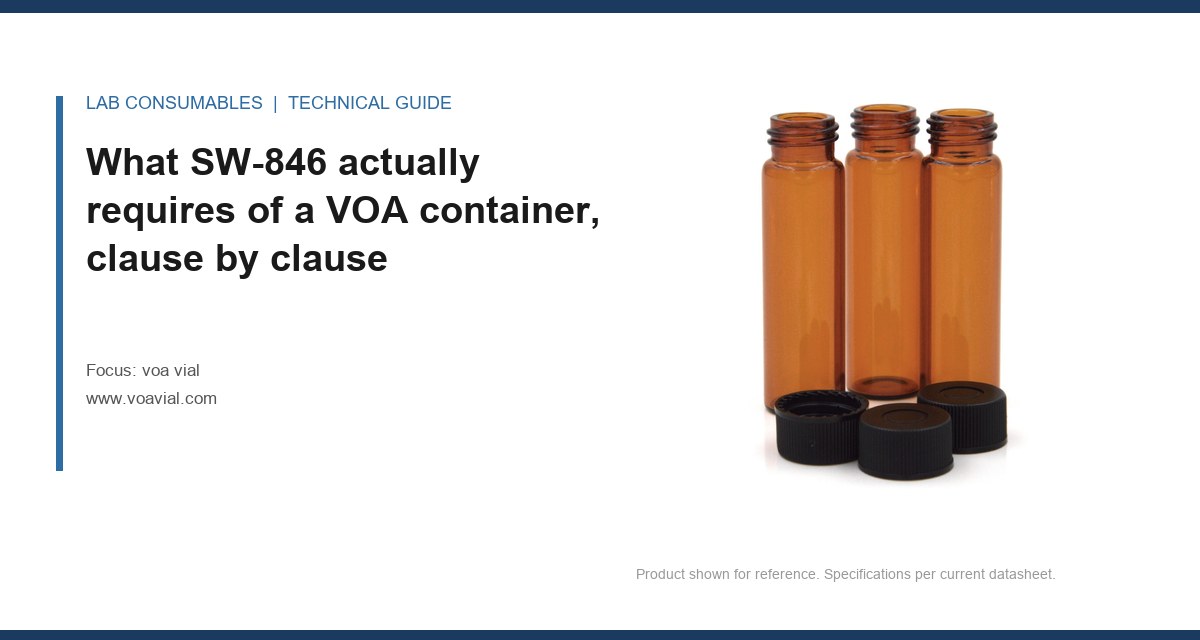
I watched an auditor pull three 40 mL vials from a September batch and set them on the bench next to a calibrated torque wrench. She didn’t ask for the chromatograms first. She asked for the container lot number, the septa certificate, and the log showing who tightened the caps and when. The run that started this audit had come back with toluene at 11.4 µg/L in a method blank that should have read below 2. The instrument was fine. The paperwork was not. That is the shape of nearly every EPA method requirements for VOA vial audit I have sat through: the chemistry gets investigated last, and the container documentation gets investigated first.
If you procure or qualify volatile organic analysis containers for a lab running SW-846 methods, the auditor is not really checking your vials. They are checking whether you can prove, on the day they ask, that the container in front of them is the container you claim it is and that it was handled in a way the method allows. This article is about what those methods actually say about containers, and the specific evidence an auditor reaches for before anything else.
SW-846 is not one document. It is a compendium, and the container language lives in a handful of places that auditors know by number. The three you will be asked about most are 5030B (aqueous purge-and-trap), 8260 (GC/MS volatiles), and 524.2 if you also run drinking water. The relevant container requirements are short, and that is exactly why auditors lean on them.
Method 5030B specifies that aqueous samples be collected in 40 mL (or larger) glass vials with PTFE-lined septa, filled with zero headspace, and preserved as required by the determinative method. Method 8260 carries the same container language and adds the holding time: 14 days from collection to analysis for preserved aqueous samples, and shorter windows for certain compounds. The U.S. EPA SW-846 test methods page is where I point new analysts, because the container clauses are easy to quote and hard to argue with.
Three specifics matter more than people expect:
- Zero headspace. Not “minimal.” Zero. A bubble the size of a pea in a 40 mL vial is roughly 0.5 mL of headspace, and that is enough to shift light volatiles on a hot day. Auditors will invert the vial and look.
- PTFE-lined septum. The liner is the only barrier between your sample and the silicone or rubber behind it. A bare silicone septum will absorb and later release hydrophobic analytes. The septa you buy should carry a liner specification you can hand to an auditor, not a generic “PTFE-faced” claim.
- Preservation and pH. For most 8260 analytes, HCl to pH < 2. The vial has to survive that, and the septum has to not degrade in it over 14 days.
Notice what the method does not specify: cap torque, septum durometer, glass grade beyond “glass,” or a puncture rating. Those are left to the manufacturer and to you. That gap is where audits get won and lost.
The paperwork an auditor asks for first, in the order they ask for it
Every audit I have supported followed roughly the same sequence. It is not random. Each document narrows the search for the next one.
1. The certificate of analysis for the container lot
They want the lot number on the box matched to a CoA that lists the analytes tested and the results. For VOA vials, the relevant test is a method blank run on the container itself, typically by purge-and-trap GC/MS, with results reported against the method reporting limit. A CoA that says “meets specifications” without numbers is a CoA that will get you a finding. What auditors want to see is a table: analyte, result, MDL, and a pass/fail against a stated limit, usually ≤ 2× the method detection limit for the target list.
2. The septum liner specification and lot
This is the one people forget. The vial and the septum are often separate line items from separate suppliers, and the auditor knows it. They will ask for the liner material (PTFE on silicone, PTFE on rubber, pure PTFE), the thickness, and the lot. If your vial septa arrived in a bag with no lot traceability, you have a documentation gap even if the septa are perfectly good. I have seen a lab pass the vial CoA review and fail on septum traceability in the same hour.
3. The receiving inspection and storage record
When did the lot arrive, where was it stored, and was it stored in the original packaging? VOA vials stored open on a shelf next to solvent bottles will pick up contamination, and auditors know that a clean CoA does not survive bad storage. A one-line log entry per lot (date received, quantity, storage location, initials) closes this.
4. The sample collection record
Field log showing who collected, when, the preservation added, and a note that the vial was filled with no headspace. If your field crew uses a VOA vial with a pre-attached cap, the log should say so, because pre-attached caps remove the open-vial window during filling and auditors treat that as a control.
5. The analytical batch record
Only now do they look at the chromatograms, and specifically at the method blank and the continuing calibration verification. If the blank is clean and the CCV is within ±20% (the 8260 criterion for most analytes), the container story holds. If the blank shows a hit, the audit loops back to documents 1 through 3.
A decision checklist for qualifying a VOA vial against method requirements
This is the checklist I use when a new lot arrives or a new supplier is being qualified. Each line has a number because “acceptable” is not a specification.
| Check | Specification | Why the auditor cares |
|---|---|---|
| Nominal volume | 40 mL ± 1 mL, or 60 mL for larger | Method 5030B container language |
| Glass | Type I borosilicate, clear | Inertness, visual headspace check |
| Septa liner | PTFE-faced, ≥ 0.010 in (0.25 mm) facing | Barrier against analyte absorption |
| Septa durometer | 45–55 Shore A (silicone backing) | Puncture consistency on autosampler |
| Puncture rating | ≥ 2 punctures at 23 G, ≤ 1 at 22 G if re-running | Septum coring and needle damage |
| Cap torque | 1.5–2.0 in·lb (≈ 0.17–0.23 N·m) | Seal integrity without cracking the neck |
| Neck finish | 18 mm screw thread, GPI 18-400 compatible | Cap and septum fit |
| Container blank | All targets ≤ 2× MDL | CoA defensibility |
| Lot traceability | CoA + septum lot on file | First document requested |
| Storage | Sealed original packaging, away from solvents | Post-receipt contamination control |
The torque number is the one that surprises people. Too loose and the PTFE liner does not seat against the neck, so you get a slow leak and a headspace bubble that grows over 14 days. Too tight and you crack the neck or deform the liner, and a deformed liner is a coring risk on the autosampler. I keep a small preset torque driver at 1.8 in·lb for cap-down checks on incoming lots. It takes 20 seconds per lot and has caught two bad cap lots in three years.
Where the method is silent: septum coring and the blank that drifts late in the batch
Here is a failure mode the methods do not describe but auditors absolutely probe. A septum that cores on the first puncture drops a small plug of silicone into the sample. That plug sits in the vial until the autosampler gets to it, and depending on the compound list, it can adsorb or slowly release analytes. The symptom is a method blank that reads clean at the start of the batch and drifts at the end, or a sample late in the sequence that shows a low-level hit not present in its duplicate.
The measurement that identifies it is a puncture-count test. Take ten vials from the lot, puncture each septum five times with the same 23 G needle your autosampler uses, and inspect the septa under a low-power loupe after each puncture. A good PTFE-faced septum shows a clean hole and no visible fragments. A bad one shows a crescent of silicone displaced into the sample side by the third puncture. I have also used a simple weight-loss check: weigh the septum before and after five punctures; more than 0.5 mg lost is a coring signal.
The fix is not exotic. Specify a septum with a thicker PTFE facing (0.010 in rather than 0.005 in), change septa on a schedule tied to puncture count rather than to calendar time, and if you re-run samples, use a fresh vial rather than re-puncturing. The Restek technical resources library has good background on septum selection if you need to justify a change to a supplier.
Two field cases: what the auditor found and the measurement that proved it
Case 1: the lot that passed the CoA and failed the torque check
A client’s September lot arrived with a clean container blank CoA. Two weeks later, a batch of groundwater samples showed cis-1,2-dichloroethene at 3.1 µg/L in the method blank, right at the reporting limit. The instrument was freshly tuned and the CCV was at 4% deviation. The auditor asked for the receiving log and the cap torque record, and there wasn’t one.
We pulled 12 vials from the lot and checked torque with a preset driver. Six of them were below 1.2 in·lb, well under the 1.5 minimum. The caps had been applied by hand at the packing line and the lot had a slightly out-of-spec neck finish (measured 17.7 mm against an 18.0 mm nominal). The loose caps let a small headspace bubble form during transport, and the bubble concentrated the light chlorinated compounds. The fix was a supplier change to a lot with a verified 18.0 mm neck finish and a documented torque of 1.8 in·lb, plus a receiving torque check on every lot. The blank came back below 0.5 µg/L on the next batch.
Case 2: the septum lot with no liner certificate
A different lab passed the vial CoA review cleanly, then failed on septum documentation. The septa were PTFE-faced silicone, visually correct, but the bag had a part number and no lot number. The auditor’s finding was not that the septa were wrong; it was that the lab could not demonstrate which septum lot was in the vials at the time of the affected batch. That is a traceability finding, and it is the kind that shows up in the report as a systemic issue rather than a single-batch issue.
The measurement that resolved it going forward was a simple incoming-inspection protocol: every septum bag gets a lot number written on the receiving log, a sample septum is retained in a labeled bag for 12 months, and the CoA is filed against the lot. The lab also moved to pre-assembled HPLC vial-style cap-and-septum units for the VOA line so the vial and septum lots are linked on a single label. That last change is what the auditor actually wanted, because it collapses two traceability chains into one.
How to build the audit file before the auditor asks
You do not need a quality system overhaul. You need a binder (physical or electronic) that answers the five questions in the order above. Here is the minimum I would assemble for any lab running SW-846 volatiles:
- Supplier qualification file per vial and septum supplier: CoA template, liner specification, neck-finish drawing, and a signed statement that the container blank is run per method.
- Lot file per received lot: CoA, receiving date, torque check result, storage location, and a retained sample vial.
- Septum file per lot: liner material, thickness, durometer, and a retained septum.
- Field collection SOP that states zero headspace, preservation to pH < 2, and the cap torque target.
- Batch record with method blank, CCV, and a note on septum change frequency.
If you buy through a distributor, get the CoA and septum lot in the same shipment. The Agilent chromatography consumables catalog is a useful reference for how a well-documented consumable spec sheet is laid out; use it as a template for what you ask your own supplier to provide. The Thermo Fisher chromatography and sample handling pages are similarly useful for cross-checking septum and cap specifications against your autosampler requirements.
The decision rule
If a lot cannot produce a container blank CoA with numbers, a septum lot with a liner specification, and a torque check within 1.5 to 2.0 in·lb, do not put it into a method batch that will be audited. The chemistry will probably be fine. The documentation will not, and the finding is the same either way. Qualify the container the way you qualify the instrument: against a written specification, with a measurement, and with a retained record for every lot.
References & further reading
Related resources from our lab consumables network:
External references and standards: