
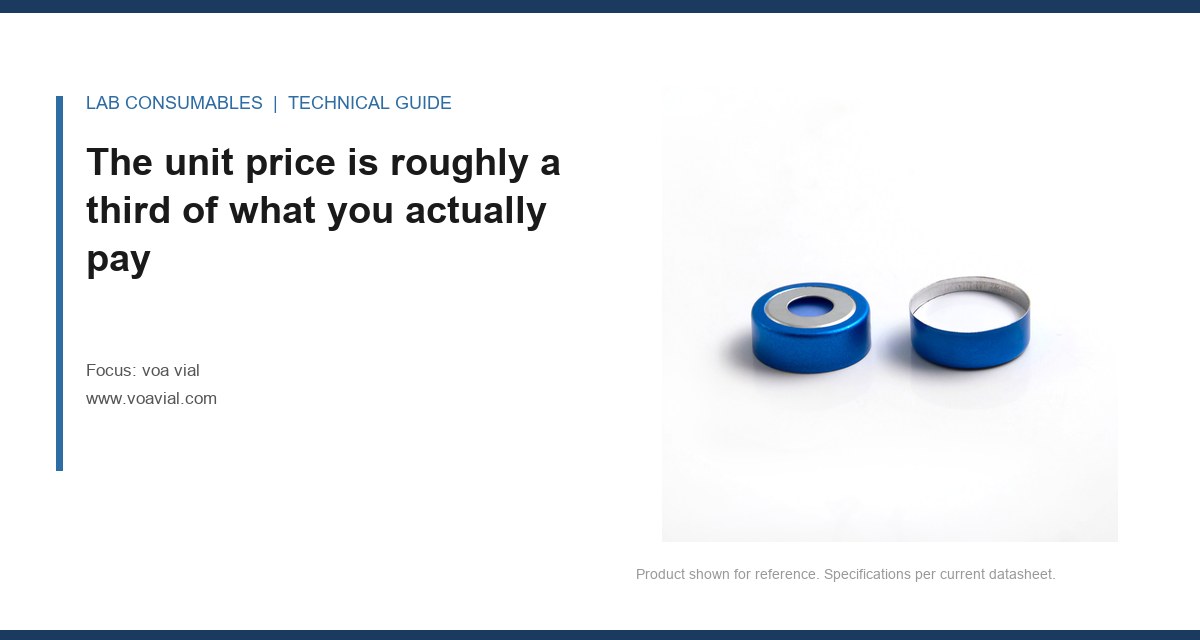
A 2 mL clear glass vial with a 9 mm screw thread and a silicone/PTFE septa was quoted at $0.19 per unit in a 50,000-piece order. Six months later, the same vial was costing that lab $0.61 per injection once freight, duty, incoming inspection, storage, and a 1.8% septum-coring failure rate were folded in. Nobody changed suppliers. Nobody changed the SKU. The unit price never moved. The voa vial landed cost calculation is what moved, and it moved because the purchasing team was tracking a number that stops at the loading dock.
This is the calculation I run every time a buyer asks me to match a competitor’s per-piece quote. It is not complicated, but it has five buckets most quotes ignore, and the biggest one is usually the smallest number on the invoice.
Start with the arithmetic that procurement teams resist. Take a typical 2 mL clear glass vial, 12 x 32 mm, 9 mm thread, with a bonded silicone/PTFE septa and a polypropylene cap. Landed cost per usable unit has five components:
- FOB unit price (what the quote shows)
- Freight and insurance (air vs. ocean, plus breakage allowance)
- Duty and customs clearance (HS code dependent, plus broker fees)
- Incoming inspection and quarantine (dimensional, extractables, particulate)
- Storage and shelf-life loss (temperature, humidity, septa aging)
- Failure cost (coring, contamination, re-runs, invalidated batches)
In the $0.19 example above, the five non-FOB buckets added $0.42 per usable unit. That is a 221% markup over the quote. It is not unusual. I have seen it run as high as 300% on air-freighted orders with a bad inspection yield, and as low as 55% on a well-managed ocean shipment of a mature SKU. The spread depends almost entirely on how carefully the buyer measures the last two buckets, which are the ones nobody quotes.
Freight is a volumetric problem disguised as a weight problem
Glass vials are light and bulky. A carton of 1,000 2 mL vials at 12 x 32 mm weighs about 8 kg gross but occupies roughly 0.028 m³. Air freight bills on volumetric weight, which for that carton is about 4.7 kg equivalent. Ocean freight bills on cubic meters, and the same carton is 0.028 CBM. That difference decides which mode you should use, and most buyers get it wrong.
For a 50,000-piece order, you are shipping 50 cartons, about 1.4 CBM, 400 kg gross. Ocean LCL from a Chinese port to a US East Coast port runs roughly $180 to $260 per CBM all-in with a minimum charge, so call it $350 to $450 for the shipment. Air freight for the same load, at volumetric weight of roughly 235 kg billable, runs $1,100 to $1,600. That is a $700 to $1,200 delta, or $0.014 to $0.024 per vial. Small, but real, and it grows with order size.
The freight number that actually bites is breakage. Glass in an LCL container gets handled six to ten times. I budget 0.5% to 1.2% breakage on ocean LCL and 0.1% to 0.3% on air palletized. On a 50,000-piece order at 1% breakage, you lose 500 vials before anyone opens the box. That is $0.002 per unit at the quote price, but it becomes $0.006 per usable unit once you divide by the surviving count. Freight insurance rarely covers glass breakage without a rider, and the rider usually costs more than the loss. Budget it, do not insure it.
What to demand from the freight quote
Ask for the volumetric weight, the CBM, the Incoterm, and the breakage allowance in writing. If the supplier quotes CIF and you are the importer of record, the freight is buried in the unit price and you cannot audit it. Move to FOB and book your own freight, or at minimum demand a freight breakdown. I have caught two suppliers padding CIF freight by 30% to 40% because the buyer never asked.
Duty is a line item, but the HS code is the decision
Vials and caps classify under HS 7010 (glass containers) or 3923 (plastic articles) depending on the dominant material and how the set is presented. A glass vial with a plastic cap and septa usually lands under 7010.90, which in the US carries a Most Favored Nation rate around 2.6% to 3.7% depending on the specific subheading. Section 301 tariffs on Chinese-origin glassware have added 7.5% to 25% at various points, and the exclusions have come and gone. A buyer who locked a landed cost model in 2019 and did not update the tariff column is now understating duty by double digits.
Do not guess the HS code. Ask the supplier for the code they declare on export, cross-check it against the US Harmonized Tariff Schedule, and confirm with your customs broker before the first shipment. A misclassification found on audit costs duty plus penalties plus interest, and the penalty can exceed the entire order value. On a $9,500 order (50,000 x $0.19), a 25% Section 301 tariff is $2,375, or $0.0475 per vial. That single line can erase the entire advantage of a cheaper supplier.
Incoming inspection is where the cheap vial reveals itself
The quote assumes 100% usable units. The invoice does not. Every incoming lot needs a sampling plan that measures the things that actually cause failures downstream. I use an AQL 1.0 general inspection level II sample, which for a 50,000-piece lot is 315 pieces, and I measure five things:
- Dimensional conformity: 12.00 ± 0.20 mm OD, 32.00 ± 0.50 mm height, 9 mm thread GPI finish. Out-of-spec vials jam autosamplers and cause needle strikes.
- Septa thickness and durometer: 1.0 mm nominal silicone with 0.13 mm PTFE facing; durometer 45 to 55 Shore A. Thin septa core early, hard septa resist the needle and bend it.
- Cap torque: 8 to 12 inch-ounces on a 9 mm screw cap, measured with a torque tester. Under-torqued caps leak during transport; over-torqued caps crack the neck or deform the septa.
- Particulate: count visible particles under 50x magnification on a 10 mL water rinse. More than 5 particles per vial fails.
- Extractables screen: run a blank injection on a representative sample and check for siloxane peaks and plasticizer peaks at the retention times your method cares about.
The inspection itself costs money: roughly $0.008 to $0.015 per vial for a 315-piece sample, plus lab time. But the inspection is where you discover that the $0.19 vial is actually a $0.19 vial 96% of the time. The other 4% is the failure cost, and that is the bucket that decides whether the cheap supplier was cheap.
Storage and shelf life are a slow tax on every vial
Septa age. Silicone absorbs volatiles, PTFE facing can delaminate, and an unsealed carton in a humid warehouse grows mold on the paper liner. I have seen a 12-month-old lot of vials produce a siloxane baseline that was three times higher than a fresh lot on the same method, and the lab spent two days chasing a ghost before pulling a fresh box.
Store vials at 15 to 25 °C, below 60% RH, in the original sealed cartons, and use within the supplier’s stated shelf life, typically 24 months from manufacture for silicone/PTFE septa. If your lab buys annual volume to chase a price break, you are trading a 3% price discount for a storage and aging cost that can exceed it. On a 50,000-piece order stored 18 months, I budget 1% to 2% loss to septa aging and packaging damage, plus the cost of climate-controlled space. That is $0.004 to $0.008 per usable unit, plus the square footage.
Failure cost is the bucket that decides the supplier
This is the number that separates a good landed cost model from a spreadsheet exercise. When a vial fails in the autosampler, you do not lose the vial. You lose the injection, the run, sometimes the batch, and occasionally the instrument time for a needle replacement. The direct cost of a single failed injection on an HPLC method with a 20-minute cycle and a $150/hour instrument rate is roughly $50 in instrument time alone. Add re-prep of the sample, the analyst’s time, and the risk of an invalidated batch, and a single coring event can cost $200 to $2,000 depending on where in the workflow it lands.
I model failure cost as a probability per injection, not per vial, because a vial that cores on the third puncture is a different problem from one that cores on the first. A good septa takes 50 to 100 punctures before coring on a 22-gauge needle; a cheap septa can core at 10 to 15. If your method uses a single puncture per vial, the failure rate is dominated by manufacturing defects (particulate, dimensional). If your method re-samples from the same vial, the failure rate is dominated by septa quality, and that is where the cheap vial is most expensive.
Worked example: $0.19 becomes $0.61
Here is the full calculation for the 50,000-piece order I opened with. Every number is a real figure from a real lot, rounded.
| Cost bucket | Basis | Cost per usable unit |
|---|---|---|
| FOB unit price | Quoted | $0.190 |
| Ocean LCL freight | $400 / 49,500 surviving units | $0.008 |
| Duty (7010.90 + Section 301) | 3.7% + 7.5% on FOB | $0.021 |
| Customs broker and clearance | $250 flat | $0.005 |
| Breakage in transit | 1.0% of 50,000 | $0.002 |
| Incoming inspection | 315-piece sample + lab time | $0.012 |
| Storage and aging | 18 months, 1.5% loss | $0.007 |
| Septum coring failures | 1.8% of vials at $50 per event | $0.360 |
| Particulate rejects | 0.3% at $0.19 replacement | $0.001 |
| Landed cost per usable unit | $0.606 |
The coring line is 59% of the total. It is also the line most buyers never calculate, because it shows up as a QC investigation, not an invoice. The fix in this case was not a cheaper vial. It was a vial septa with a bonded PTFE facing and a controlled durometer, which cut the coring rate from 1.8% to 0.2% and dropped the landed cost to $0.28 per usable unit even though the FOB price rose to $0.23. The more expensive vial was 54% cheaper to use.
Two field cases where the landed cost model caught the problem
Case 1: the autosampler jam that was a dimensional problem
A pharma QC lab was running an Agilent 1260 autosampler with a 9 mm vial tray and reporting intermittent needle strikes, about one every 400 injections. The symptom looked like a needle problem. The measurement that identified it was a dimensional check on 100 vials from three lots: the OD on one lot ran 12.28 mm against a 12.00 ± 0.20 mm spec, so about 8% of that lot was out of tolerance. Out-of-spec vials sat high in the tray and the needle clipped the shoulder. The fix was a lot rejection and a supplier change, but the landed cost lesson was the inspection line: the $0.012 per vial inspection caught a defect that would have cost roughly $3,200 in instrument downtime and needle replacements over the lot’s life. The buyer had been skipping incoming inspection to save the $600 inspection cost on a 50,000-piece order. The inspection was the cheapest line in the model.
Case 2: the siloxane baseline that came from the warehouse
An environmental lab running EPA SW-846 Method 8260 on a GC-MS started seeing a siloxane peak at m/z 281 that drifted upward over three weeks. The column was new, the liner was new, and the septa were the same lot as always. The measurement that identified it was a headspace run on a blank vial from the same carton versus a blank vial from a freshly received carton: the stored carton showed a siloxane response 2.7 times higher. The carton had been stored in a warehouse bay that hit 32 °C in summer, and the septa had absorbed volatiles from the cardboard and the adjacent solvent storage. The fix was a move to a climate-controlled room at 20 °C and a FIFO rotation that capped vial age at 12 months. The landed cost model had been understating the storage bucket by treating it as free. It was not free. It was a 2.7x baseline drift that cost three weeks of method troubleshooting.
The comparison that decides a supplier: cost per usable unit, not per piece
When you put two suppliers side by side, do not compare quotes. Compare cost per usable unit, and force the failure cost into the model. Here is the decision checklist I use.
| Parameter | Cheap supplier | Qualified supplier | Why it matters |
|---|---|---|---|
| FOB price | $0.19 | $0.23 | Starting point only |
| Dimensional Cpk on OD | 0.9 | 1.5 | Cpk below 1.33 predicts autosampler jams |
| Septa durometer | 40 Shore A | 50 Shore A | Soft septa core early |
| Puncture count to coring (22G) | 12 | 65 | Drives failure cost on re-sampled methods |
| Cap torque as received | 5 to 7 in-oz | 9 to 11 in-oz | Below 8 in-oz leaks in transit |
| Particulate per vial | 8 | 2 | Above 5 fails the rinse test |
| Stated shelf life | 12 months | 24 months | Shorter life raises storage loss |
| Cost per usable unit | $0.61 | $0.28 | The only number that matters |
The qualified supplier wins by 54% even though the quote is 21% higher. That is the entire argument for running the landed cost calculation before you run the price comparison. If you want the specs behind the septa numbers, the septa reference library covers durometer, facing thickness, and puncture testing in more detail than any quote sheet will.
A troubleshooting checklist for a landed cost model that has gone wrong
If your actual cost per usable unit is drifting above your model, work through these in order. The first three catch most of the error.
- Reconcile the duty line against the current tariff schedule. Section 301 and antidumping rates change. A model built 18 months ago is stale.
- Pull the last four incoming inspection reports and calculate the actual reject rate. If it is above 2%, the quote is not the price.
- Count coring events from the instrument log, not from memory. Most labs undercount by half because coring that does not cause a visible failure still degrades the baseline.
- Check storage temperature and age. A data logger in the vial cabinet costs $40 and settles the argument.
- Verify the HS code with your broker. A misclassification is a duty penalty waiting for an audit.
- Measure cap torque on receipt. A $300 torque tester catches under-torqued lots before they leak in the autosampler.
For the analytical side of the same problem, the HPLC vial and Agilent consumables documentation gives you the autosampler dimensional tolerances to inspect against, and Restek’s technical resources cover septa bleed and coring behavior across needle gauges. The Thermo Fisher sample handling guides are useful for the re-sampling methods where puncture count dominates failure cost. For the regulatory frame around extractables and method validation, EPA SW-846 is the reference I cite when a batch is invalidated and the failure has to be documented.
One note on the sourcing side: the landed cost model tells you which supplier is cheaper to use, not how to structure the contract around them. That is a separate problem, and the sibling article on contract terms covers it. Keep the two decisions apart. A supplier can win on landed cost and still be the wrong supplier to depend on for 100% of volume.
The decision rule: buy on cost per usable unit, and price the failure bucket honestly
Run the landed cost calculation before you run the price comparison, and force the failure cost line into the model with a real coring rate from your instrument log, not a guess. If the coring rate is unknown, measure it on a 500-injection pilot before you commit to an annual order. A vial that costs $0.19 and cores at 1.8% is a $0.61 vial. A vial that costs $0.23 and cores at 0.2% is a $0.28 vial. The quote is the smallest number in the model, and the failure bucket is usually the largest. Buy the one with the lower cost per usable unit, and keep the inspection line funded so the model stays honest. If you are still comparing FOB prices after reading this, you are comparing the wrong number. The full voa vial specification set, including dimensional tolerances and septa durometer, is the input you need to start the calculation.
References & further reading
Related resources from our lab consumables network:
External references and standards: