
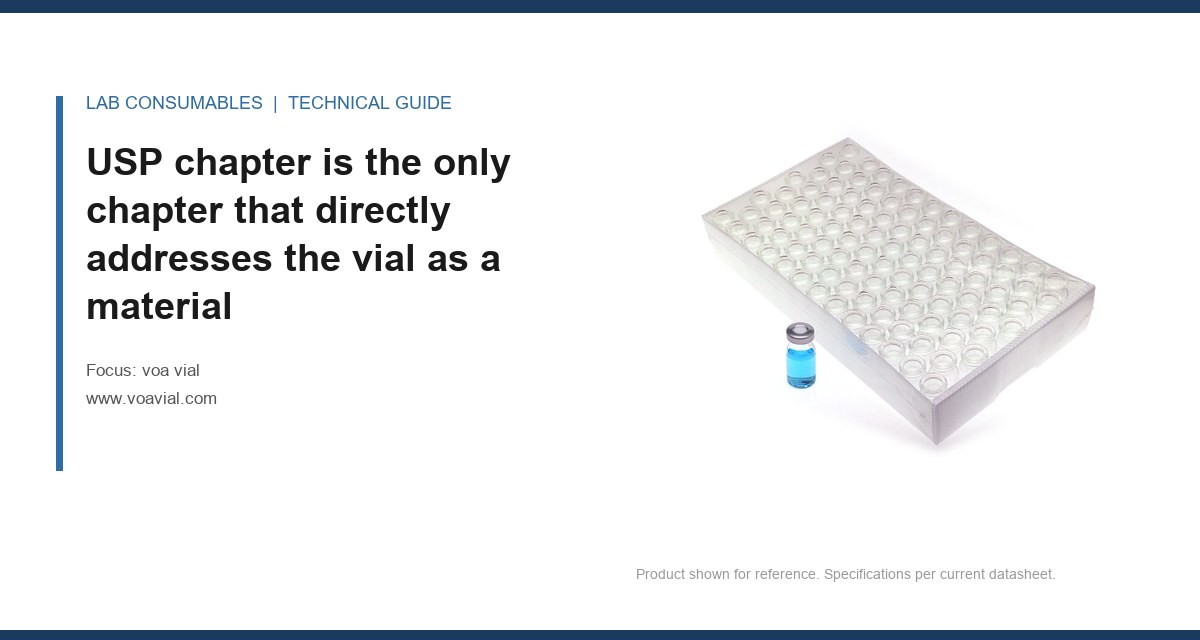
A 40 mL clear borosilicate voa vial lot failed its first blank run in a purge-and-trap GC/MS method. The tetrachloroethylene peak came in at 0.8 µg/L against a 0.2 µg/L action limit. The analyst had already swapped the trap, baked the transfer line, and re-run the calibration before anyone pulled the septum and looked at the headspace. The vial itself was the source. That failure, and the three weeks of rework it caused, sits at the center of what USP requirements for voa vial in a validated method actually mean in practice. USP does not hand you a part number. It hands you a set of chapters that constrain how you prove the consumable is fit for use in a method that has already been validated.
General chapter <661.1> Plastic Materials of Construction is the one most labs cite when they talk about vial compliance, but the citation is often wrong in one important way. <661.1> applies to plastic materials. A voa vial is normally Type I borosilicate glass, which falls under <660> Containers—Glass. The plastic septum liner, the cap material, and any plastic-coated glass all fall under <661.1>. So when someone says a voa vial is “USP compliant,” the accurate statement is that the glass body meets <660> and the closure system meets <661.1> where applicable. That distinction matters because the two chapters test different things and the failure modes are different.
<660> sets limits on extractable alkalinity, arsenic, and the hydrolytic resistance of the glass surface. Type I borosilicate glass is the only glass class suitable for volatile organic analysis because it has the lowest extractable profile and the highest hydrolytic resistance. A Type III soda-lime vial will leach sodium and boron under heat and moisture, and in a purge-and-trap method that runs at 40 °C to 80 °C during purging, that leaching shows up as ghost peaks and elevated baselines. I have seen a Type III vial produce a siloxane background that tripled the noise in a 624 method. The fix was not method adjustment. It was replacing the vial.
The closure system is where most voa vial failures originate. The septum is a laminate, typically PTFE-faced silicone or PTFE-faced butyl. <661.1> requires that plastic components not release substances that alter the safety, efficacy, or quality of the drug product or, in an analytical context, the sample. The practical translation is that the septum must not bleed volatile compounds into the headspace during storage or heating. A silicone-only septum without a PTFE face will bleed cyclic siloxanes (D3, D4, D5, D6) directly into the sample. Those siloxanes co-elute with several target analytes in EPA 8260 and USP <467> residual solvents methods. The PTFE face is not a luxury. It is the barrier that keeps silicone bleed out of the sample.
USP chapter <467> residual solvents reaches the vial through the blank, not through a material spec
USP <467> Residual Solvents is the chapter that actually drives voa vial selection in pharmaceutical QC. The method uses headspace GC with FID or MS detection. The analytes are Class 1, Class 2, and Class 3 solvents at limits that range from 2 ppm for benzene to 5000 ppm for ethanol. The vial is not mentioned by name in <467>, but every blank run is a direct test of the vial’s contribution. If the vial or septum releases any of the target solvents, the blank fails and the entire sequence is invalid.
The specific failure I see most often is methylene chloride. Methylene chloride is a Class 2 solvent with a limit of 600 ppm in <467>. It is also a common cleaning solvent in manufacturing. A vial that has been rinsed with methylene chloride and not properly baked will carry residual solvent into the headspace. The same is true for acetone, which appears as a contaminant in many plastic cap materials. A polypropylene cap that has not been pre-cleaned will release acetone and toluene when heated to 105 °C during headspace equilibration. The blank run catches it, but only if the lab runs a blank after every new lot of vials. That is the operational rule: no new vial lot enters a validated method without a full method blank.
USP <467> also specifies headspace conditions. The typical equilibration temperature is 80 °C to 105 °C, with 30 to 60 minutes of equilibration. The voa vial must hold a pressure of 2 to 3 bar during that equilibration without leaking. A crimp cap that is not seated correctly will leak at 2 bar and the headspace concentration will drop, producing a false low result. The torque on a crimp cap is not specified by USP, but the practical range for a 20 mm crimp is 18 to 22 inch-pounds. Below 18, the seal is unreliable. Above 22, the septum deforms and can tear. I have measured RSD values of 12% to 18% on benzene replicates from a single lot of vials that were under-torqued. The same lot at 20 inch-pounds gave 3.1% RSD.
USP chapter <621> chromatography sets the system suitability rules that expose vial problems
USP <621> Chromatography is the chapter that defines system suitability parameters: resolution, tailing factor, theoretical plates, and repeatability. None of these parameters mention the vial, but all of them are sensitive to vial-induced contamination. A voa vial that bleeds a co-eluting compound will raise the baseline and reduce the signal-to-noise ratio for late-eluting analytes. That change shows up as a tailing factor drift or a resolution failure between two critical pairs.
In a <467> method, the critical pair is often benzene and 1,4-dioxane, or toluene and ethylbenzene. Resolution between benzene and 1,4-dioxane must be at least 1.5. If the vial contributes a small amount of toluene, the benzene peak area increases and the resolution calculation shifts. The analyst sees a system suitability failure and assumes the column is degraded. The column gets replaced, the failure persists, and the investigation stalls. The correct diagnostic step is to run a blank from a different vial lot. If the blank is clean, the original vial lot is the problem. That single test saves more time than any column bake-out.
<621> also requires that the repeatability of injection, expressed as RSD, meet a specified limit, often not more than 2.0% for a five-replicate injection of a standard. A voa vial with a septum that reseals poorly after puncture will produce variable headspace pressure and variable injection volumes. The RSD climbs. A PTFE-faced silicone septum can typically withstand 2 to 3 punctures before resealing fails. A PTFE-faced butyl septum can withstand 5 to 8 punctures. If the method requires multiple injections from the same vial, the butyl septum is the correct choice, even though it costs more. The puncture count is a specification that USP does not set but that the lab must set for itself.
What USP leaves to the lab: a specification the method must define
USP chapters <660>, <661.1>, <467>, and <621> set the framework. They do not set a puncture count, a torque value, a bake-out temperature, or a maximum siloxane bleed level. Those numbers belong to the lab’s own specification, and a validated method is incomplete without them. The method validation report should include a consumable specification section that lists the exact vial dimensions, glass type, closure type, septum material, septum thickness, cap material, and the acceptance criteria for a blank run.
The dimensions are not arbitrary. A 20 mL voa vial has a standard body diameter of 22.5 mm and a height of 75.5 mm. A 40 mL voa vial has a body diameter of 27.5 mm and a height of 98 mm. The neck finish is 24-414 for the 40 mL and 20-400 for the 20 mL. Using a 20-400 cap on a 24-414 neck will not seal, regardless of torque. I have seen a purchasing department substitute a 20-400 cap on a 24-414 vial because the price was lower. The entire lot leaked at headspace pressure and the lab lost a full day of runs. The specification must include the neck finish, not just the vial volume.
The septum thickness also matters. A standard PTFE-faced silicone septum is 1.3 mm to 1.5 mm thick. A thicker septum, 2.0 mm to 3.0 mm, provides better resealing after puncture but reduces the headspace volume slightly and can absorb some analytes. For volatile organic analysis, a 1.3 mm PTFE-faced silicone septum with a shore A hardness of 50 to 55 is the standard. The PTFE face should be 0.25 mm to 0.5 mm thick. A thinner PTFE face will tear during puncture and expose the silicone to the sample. The tear is visible under magnification, but most labs never look. They see the elevated siloxane background and chase the instrument instead.
Bake-out and pre-cleaning: the step that separates a clean vial from a compliant vial
A USP-compliant voa vial is not necessarily a clean voa vial. <660> and <661.1> test for extractables under defined conditions, but they do not guarantee that the vial is free of volatile residues from manufacturing. Glass vials are formed at high temperature, but they are also packed, shipped, and stored. Plastic caps and septa pick up volatile compounds from packaging materials. The lab must bake out or pre-clean vials before they enter a validated method, and the bake-out conditions must be part of the specification.
The standard bake-out for voa vials is 105 °C for 2 hours in a clean oven. That temperature is high enough to drive off residual solvents and low enough to avoid damaging the septum. The septum should not be baked at temperatures above 150 °C, because the PTFE face will begin to degrade and the silicone will release additional siloxanes. For methods that require ultra-low background, a bake-out at 250 °C for 2 hours for the glass body alone, with the septum and cap added after cooling, is the correct procedure. The glass can withstand 250 °C. The septum cannot.
The bake-out step must be validated. That means running a blank after bake-out and confirming that all target analytes are below the method detection limit. A lot of vials that passes that blank is acceptable for use. A lot that fails is rejected or re-baked. The validation report should record the bake-out temperature, duration, and the blank result for each lot. That record is not an audit requirement. It is the only way to trace a future failure back to a specific lot.
Decision checklist: what a USP-aligned voa vial specification must include
The following checklist is the minimum set of parameters I require before a voa vial lot is approved for a validated method. Each parameter has a concrete number or a test method attached. If a supplier cannot provide the number or the test result, the lot is not approved.
- Glass type: Type I borosilicate, USP <660> hydrolytic resistance class HGB 1 or better
- Glass dimensions: 20 mL (22.5 mm body diameter, 75.5 mm height, 20-400 neck) or 40 mL (27.5 mm body diameter, 98 mm height, 24-414 neck)
- Septum material: PTFE-faced silicone, PTFE face 0.25 mm to 0.5 mm, total thickness 1.3 mm to 1.5 mm, shore A 50 to 55
- Septum puncture rating: 2 to 3 punctures for silicone, 5 to 8 for butyl, before resealing failure
- Cap material: Polypropylene, pre-cleaned, with a crimp seal rated to 3 bar
- Crimp torque: 18 to 22 inch-pounds for 20 mm crimp caps
- Bake-out: 105 °C for 2 hours for complete assembly, or 250 °C for 2 hours for glass body alone
- Blank acceptance: All target analytes below method detection limit after bake-out
- System suitability after lot change: Resolution ≥ 1.5 for critical pair, RSD ≤ 2.0% for five replicates
This checklist is not a USP requirement. It is the lab’s own specification, built to satisfy USP chapters <660>, <661.1>, <467>, and <621> in a method that has already been validated. The distinction is important. USP tells you what the material must not release. It does not tell you how to prove that a specific lot of vials meets that requirement in your method. That proof is the lab’s job.
Field case 1: the siloxane background that was not a column problem
A pharmaceutical QC lab running USP <467> on a drug substance reported a rising baseline in the FID chromatogram. The baseline rose from 2 pA to 18 pA over a 12-minute run, and the noise increase was worst in the region where cyclic siloxanes elute. The analyst replaced the column, baked the inlet, and changed the liner. The baseline did not improve. The lab manager then ran a blank from a new, unopened box of voa vials from the same lot. The blank showed the same siloxane pattern. The septum was a 1.0 mm PTFE-faced silicone with a PTFE face of only 0.1 mm. The thin PTFE face had torn during puncture, and the silicone was bleeding D4 and D5 directly into the headspace. The fix was to switch to a septum with a 0.4 mm PTFE face and a total thickness of 1.5 mm. The baseline dropped to 3 pA and the method passed system suitability on the next run. The column that had been replaced was not the problem. The septum was.
Field case 2: the low benzene recovery that was a torque problem
An environmental lab running a purge-and-trap method for volatile aromatics saw benzene recovery drop from 95% to 72% over a two-week period. The internal standard recovery also dropped, which ruled out a calibration issue. The analyst checked the purge flow, the trap, and the transfer line. All were within specification. The problem was the crimp caps on a new lot of 40 mL voa vials. The caps had been crimped by hand with a tool that was not calibrated. The torque measured on ten randomly selected vials ranged from 10 to 16 inch-pounds. At that torque, the septum was not compressed enough to seal, and the headspace was losing pressure during the 11-minute purge. The benzene was being purged out of the vial before it reached the trap. The fix was to calibrate the crimping tool to 20 inch-pounds and re-crimp all vials in the lot. Recovery returned to 94% on the next sequence. The vial itself was fine. The closure was not.
Where USP requirements for voa vial in a validated method stop and your specification begins
USP chapters <660> and <661.1> set the material limits. USP <467> sets the analyte limits that the blank must meet. USP <621> sets the system suitability parameters that will expose a vial problem. None of these chapters tells you the puncture count, the torque value, the bake-out temperature, or the blank acceptance criterion for your specific method. Those numbers come from your own validation work, and they must be written down. A voa vial is not “USP compliant” in a meaningful sense until the lab has demonstrated that a specific lot, under specific conditions, produces a blank that meets the method’s detection limits and a system suitability run that meets the method’s resolution and repeatability requirements.
The decision rule is simple. If a voa vial lot passes a full method blank after bake-out, and the system suitability parameters remain within specification after the lot is introduced, the lot is acceptable. If it fails either test, the lot is rejected, regardless of what the supplier’s certificate says. The certificate is a starting point. The blank run is the decision. For sourcing, the vial body should be Type I borosilicate from a supplier that can provide <660> hydrolytic resistance data. The septum should be a PTFE-faced silicone or butyl from a supplier that can provide <661.1> extractables data. The Voa Vial product line at voavial.com carries both glass types and both septum materials, and the Septa and Vial Septa lines cover the closure options. For HPLC-related consumables in the same workflow, Hplc Vial has the matching products. On the instrument side, Agilent chromatography consumables and columns and Thermo Fisher chromatography and sample handling provide the reference hardware. For method-specific guidance on volatile organic analysis, U.S. EPA SW-846 test methods for waste and materials and Restek technical resources for chromatography cover the application side.
The decision rule: a voa vial is acceptable for a validated method only when a post-bake-out blank from that lot shows all target analytes below the method detection limit, and a system suitability run after lot introduction meets the resolution and RSD limits in USP <621>. Anything less is a certificate, not compliance.
References & further reading
Related resources from our lab consumables network:
External references and standards: